
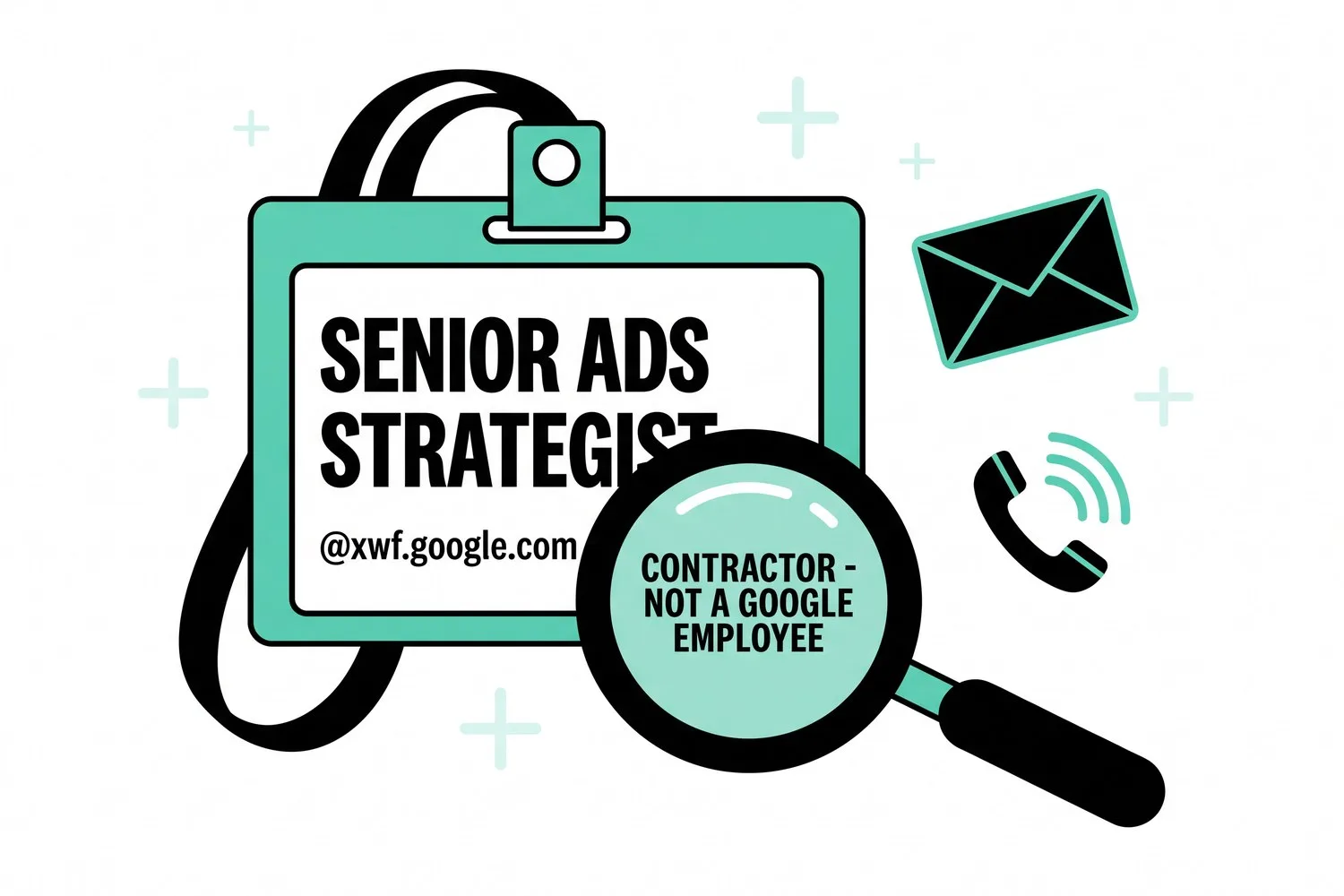
Got an email from a “Senior Ads Strategist” at an address ending in @xwf.google.com? Read this before you book the call. Short version: it is a real Google domain, but the person writing to you is not a Google employee, does not manage your account, and is paid to sell.
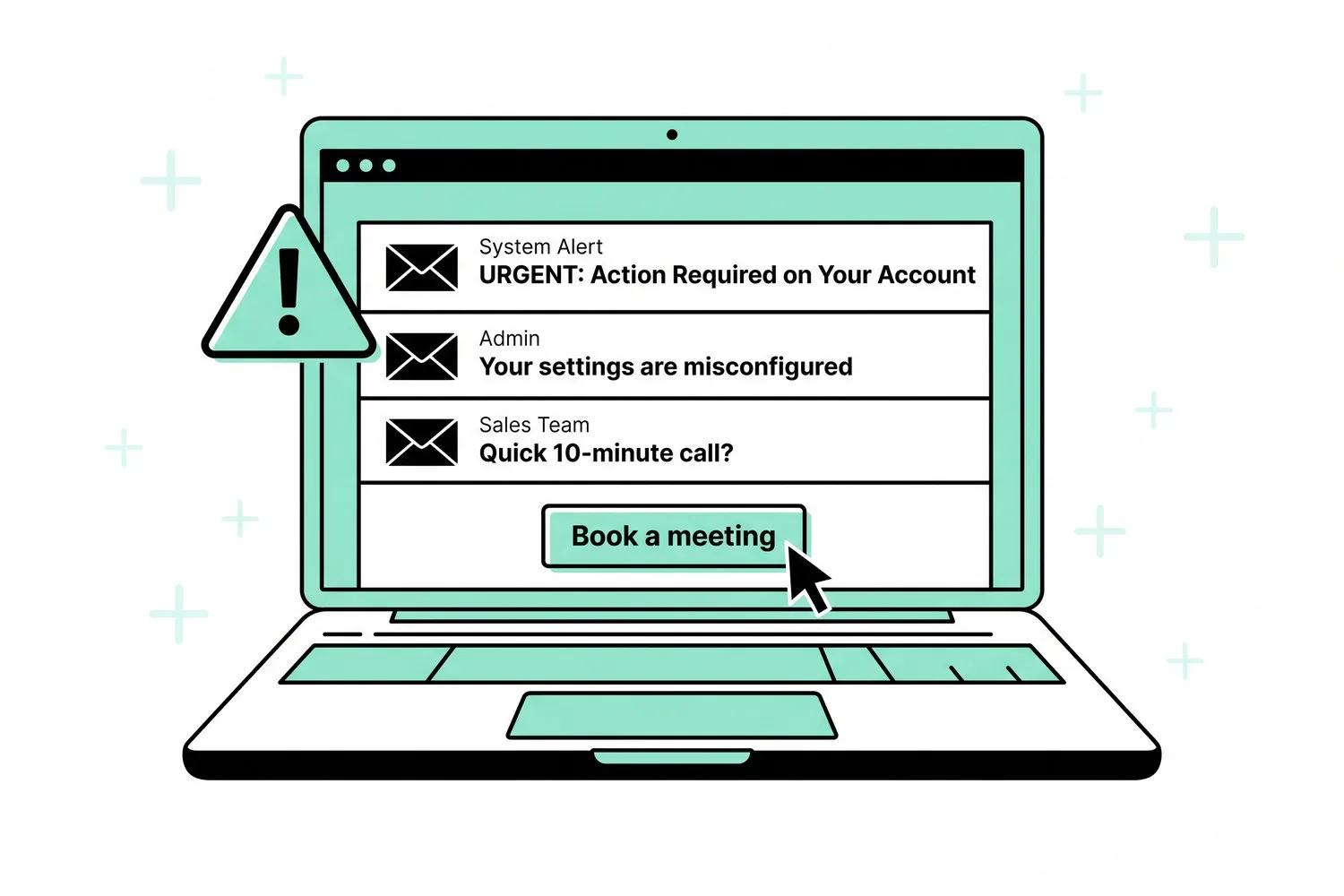
The email that started this article
Last week a practice owner we work with forwarded us an email and asked us to “get clear on what the situation is.” It came from a “Senior Ads Strategist” with an @xwf.google.com address. It opened with:
“I am stepping in as the Senior Ads Strategist managing your Google Ads account.”
It then warned that the account’s goals, bidding and settings were “misconfigured,” that this was “causing a direct drop in performance,” and asked for “10 minutes for a quick call.” The signature named the strategist’s real employer in small print: WNS, an outsourcing company.
Three things were wrong with it:
- Nobody “stepped in” to manage anything. We manage that account. The sender has no role in it.
- No problem was named. “Misconfigured” and “a direct drop in performance” with no number, no campaign and no setting is a sales opener, not a diagnosis.
- The subject line named a different company’s ad setup. It was a template, sent in bulk, and nobody had swapped the name.
If an email like this has landed in your inbox, you are not alone, and it is not a scam in the usual sense. It is something more ordinary: a sales call dressed up as account support. Here is what it is, who sends it, what they are measured on, and what to do.
The 30-second version
- @google.com = a Google employee. @xwf.google.com = a contractor employed by an outsourcing firm. Anything else claiming to be Google = treat as a scam.
- XWF reps sit in Google’s sales organization, not support. Google has said its sales reps have competitive targets and earn commissions.
- What they push (bigger budgets, broad match, auto-applied recommendations, Performance Max, AI Max) moves their numbers. Whether it moves your patient bookings is a separate question.
- Never give account access or accept changes on a call. Forward it to your agency first.
What “XWF” actually means
XWF stands for eXtended WorkForce. It is the email domain Google gives to people who work on Google projects but are employed by someone else. Google is explicit about this on its own corporate site:
“Extended workforce members are not, and have never been, Google employees.”
Google says these vendors and temporary staff are employed solely by its suppliers and staffing partners, who also set their pay and working conditions.
For Google Ads specifically, Google’s help center lists the companies doing this outreach and confirms the domain:
“Google representatives always have an email address that ends with @xwf.google.com.”
The partner list on that page reads like a directory of global call-center and outsourcing companies: Accenture, Atento, Cognizant, Concentrix, Regalix/Marketstar, TDCX/Teledirect, Teleperformance, TMJ, TTEC and WNS. That is where the “strategist” in our client’s inbox works.
This is not a small side program. In 2019 The New York Times reported, from an internal document, that Google worked with roughly 121,000 temps and contractors worldwide against about 102,000 full-time employees (Fast Company). The people who email advertisers are one slice of that workforce.
These are sales roles, not support roles
This is the part most practice owners miss. The email says “strategist,” “managing your account,” and “support.” The job is sales.
When advertisers complained to Search Engine Land about aggressive calls pushing automation, Google’s own spokesperson clarified that those calls come from the sales team, not support, and that sales reps have competitive targets and are rewarded with performance-related commissions (Search Engine Land). Actual technical support at Google is a different team.
Agencies on the receiving end put it bluntly. Anthony Higman, CEO of Adsquire, told Search Engine Land that despite “thousands” of emails and calls:
“No one who has contacted us has actually offered any support.”
— Anthony Higman, CEO, Adsquire
PPC consultant Peter Bowen added that, in his view, Google has never really explained the difference between the two teams to the people it calls.
What the reps are actually measured on
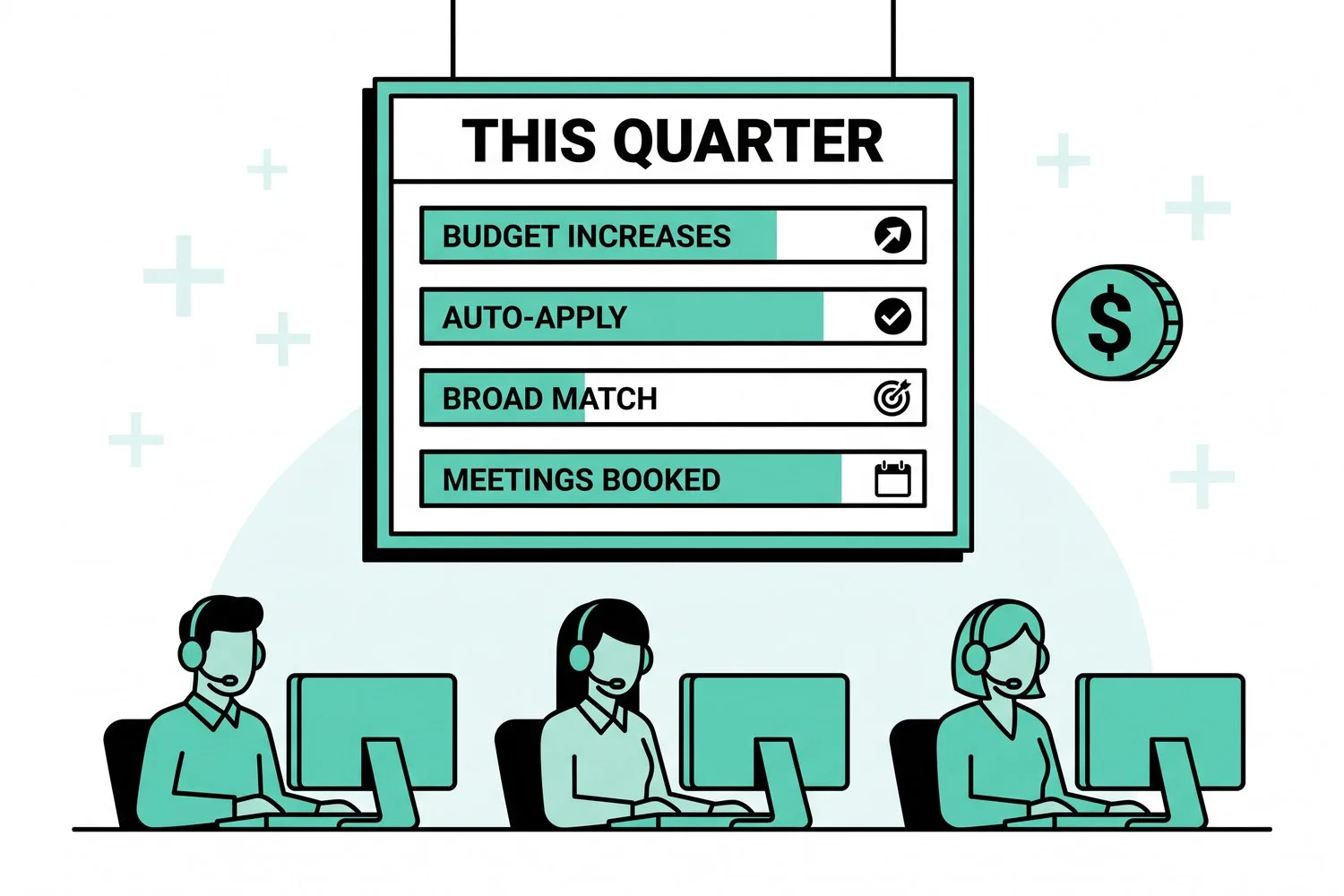
Google does not publish its reps’ scorecards. But former reps have described them, and the descriptions line up.
In an interview published by ZATO PPC Marketing, a former Teleperformance Google Ads strategist said their goals included getting a “full implementation” on 30% of assigned clients plus blended revenue targets. The products they pushed were mostly automated bidding, auto-applied recommendations, recommendations in general, and budget increases. They described carrying around 300 accounts in their first months, being reorganized onto a new team almost every quarter, and an employer that cared far more about selling than about whether reps understood the products. On how reps hit targets that were not realistic organically:
“I just stalked change history and set up alerts.”
— Former Teleperformance Google Ads rep, via ZATO PPC Marketing
In other words: when an advertiser or their agency made a change on their own, some reps would claim it as an “implementation.” The same rep said training covered only the benefits and success stories of auto-applied recommendations, and that many reps learned the downsides from advertisers.
Dennis Moons of Store Growers, who has been tracking these emails since 2024, sums up the conflict in one line:
“Their incentives don’t align with yours.”
— Dennis Moons, Store Growers
Clique Agency made the same point from a different angle, and it is our favourite line on the topic:
“Nobody has ever called to tell you your budget is too high.”
What they push, and why it matters for a medical practice
Across the sources above and our own inbox, the asks are almost always the same:
- Raise the daily budget.
- Switch keywords to broad match.
- Turn on auto-applied recommendations, so Google can change the account without asking.
- Move to fully automated bidding, often with a looser or no cost target.
- Launch Performance Max, Demand Gen or AI Max, campaign types that give Google more control over where the money goes.
None of these is always wrong. Each of them is a lever that tends to increase spend. For an e-commerce store with clean revenue tracking, that can sometimes be fine. For a plastic surgery practice, a med spa or a clinic, it is risky, because:
- Your real conversion happens offline. A form fill is not a consult, and a consult is not a surgery. Automation that optimizes for cheap “leads” will happily buy you more people who never book.
- Broad match in medicine wanders fast. A search for a procedure easily drifts into competitor names, research queries, cheap alternatives and jobs. We have spent years building negative keyword lists for exactly this reason.
- Auto-applied changes can quietly undo deliberate decisions. Search Engine Land reported that when Google first rolled out auto-applied recommendations, those changes did not even appear in the normal change history (Search Engine Land).
The damage is not hypothetical. Google Ads consultant Claire Jarrett described auditing an orthodontist’s account where auto-applied recommendations had added display campaigns, broad match keywords and more; the practice went from about 15 leads a day to 2, and nobody at the practice had made those changes (Claire Jarrett). Garrett Digital reported a client whose spend doubled within a week of following a rep’s broad match plan, and summed up the experience of trying to stop the calls:
“Polite requests get ignored, and some reps turn aggressive.”
It isn’t just you: agencies are pushing back
In 2025, Digiday reported that agencies were “calling foul” on reps who contact their clients directly, present themselves as PPC specialists, and push AI products such as Performance Max, sometimes with advice that contradicts the agency’s strategy. One agency COO said reps had moved from monthly to weekly calls and were reaching clients across 10–15% of the agency’s accounts. Ian Harris, founder of the UK agency network Agency Hackers, which launched a “Don’t Be Evil” campaign about it, said:
“No other industry would put up with this.”
— Ian Harris, Agency Hackers, via Digiday
There is a structural reason agencies feel pressure too. To keep Google Partner status, an agency’s accounts need an optimization score of at least 70%, a score driven by how Google’s recommendations are handled (Search Engine Land). After pushback Google allowed agencies to reach that score by dismissing recommendations instead of applying them, but the incentive tells you how Google thinks about recommendations: as something to adopt.
Google has acknowledged the complaints. When agencies publicly flagged a third-party rep’s budget advice, Google’s Ads Liaison Ginny Marvin responded:
“We are listening and take this feedback seriously.”
— Ginny Marvin, Google Ads Liaison, via Search Engine Roundtable
And in mid-2026, Google Ads Product Expert Emmanuel Flossie spotted that these “book a call” emails had finally started carrying an unsubscribe link, after years of complaints (PPC Land).
To be fair: some reps are good
We don’t think every rep is the problem. Many are early-career people working under a system that rewards adoption over results. Some do real work. Melissa Mackey, Director of Paid Search at Compound Growth Marketing, told Optmyzr about a rep who escalated a remarketing issue and fought for a refund:
“Our rep is focused on our client’s goals.”
— Melissa Mackey, via Optmyzr
Reps can genuinely help with disapproved ads, billing problems, suspensions and access to beta features. The test is simple: is the advice tied to your goals, in writing, with numbers you can check? If yes, great. If it is “10 minutes on a call” about an unnamed misconfiguration, it is a pitch.
How to tell who is really contacting you
| Sender address | Who it is | What to do |
|---|---|---|
| @google.com | A Google employee (check the display name: some contractors show “(xWF)” there) | Fine to talk, still loop in your agency |
| @xwf.google.com | A contractor at an outsourcing firm, working in Google Ads sales | Treat as a sales pitch; forward to your agency |
| Anything else (e.g. google-ads-support.com, gmail.com) | Not Google | Don’t click, don’t reply, report as phishing |
Store Growers notes a useful tell: a legitimate XWF email usually references your real account name or number and may copy other people who have access to the account. A scammer would not have that information.

What to do when one lands in your inbox
- Check the domain. @xwf.google.com means contractor and sales. Read it in that light.
- Forward it to your agency before you reply. If we manage your ads, send it to us. We will tell you in plain words whether anything in it is real.
- Never share passwords or codes, and never grant account access. A rep does not need either to make a recommendation.
- Don’t agree to anything on a call. Ask for the recommendation in writing, with the specific campaign, the setting, and the expected effect on cost per booked consultation.
- Ask what they are measured on. It is a fair question, and the answer is useful.
- Say no once, in writing. Reply asking them to stop contacting you about the account, and use the unsubscribe link if the email has one.
- Keep auto-applied recommendations off unless your agency has chosen specific ones deliberately.
What we tell our clients
This is, almost word for word, the reply our founder sent to the practice that forwarded the email above:
“XWF are sales reps on sales quotas, not support metrics. Their job is to book consultations and push clients toward spending more on ads. They are told to push automated bidding, budget increases and new AI features, because those move the needle on quota fastest.”
— Andrew Zolotovskovs, CEO, Anzolo
And on how to recognize one:
“A real Google employee will have an @google.com email… and they will never open like this.”
— Andrew Zolotovskovs
The bottom line
Emails from @xwf.google.com are legitimate in one narrow sense: Google controls the domain and the sender is authorized to contact you. They are not neutral, they are not from a Google employee, and the sender is not managing your account. Their incentives are built around adoption and spend, set by Google and their employer.
Your incentive is booked consultations at a cost that makes sense. Those two can overlap. When they don’t, you want someone in your corner who is paid on the second one.
Got one of these emails? Forward it to us at [email protected] and we’ll tell you whether there is anything in it worth acting on.
Sources
- Google — About our extended workforce
- Google Ads Help — About our third-party partners
- Search Engine Land — Google clarifies the difference between Ads sales and support
- ZATO PPC Marketing — Secrets of a Google Ads 3rd-party support rep
- Store Growers — Google’s Sales Bloodhounds
- Clique Agency — Google Ads XWF reps
- Garrett Digital — Google Ads reps won’t stop calling?
- Digiday — Agencies call foul as Google reps play hardball with AI pitches
- Optmyzr — This is your Google Ads rep speaking
- Search Engine Roundtable — Google Ads to address concerns over third-party sales solicitations
- Search Engine Land — Optimization scores and Google Partner agencies
- Search Engine Land — Auto-applied recommendations catch advertisers off guard
- Claire Jarrett — The honey trap inside your Google Ads account
- PPC Land — Google Ads reps gain opt-out link after years of spam complaints
- Fast Company — Google has 121k temps and contractors vs 102k full-time staff

